
Research Scientific
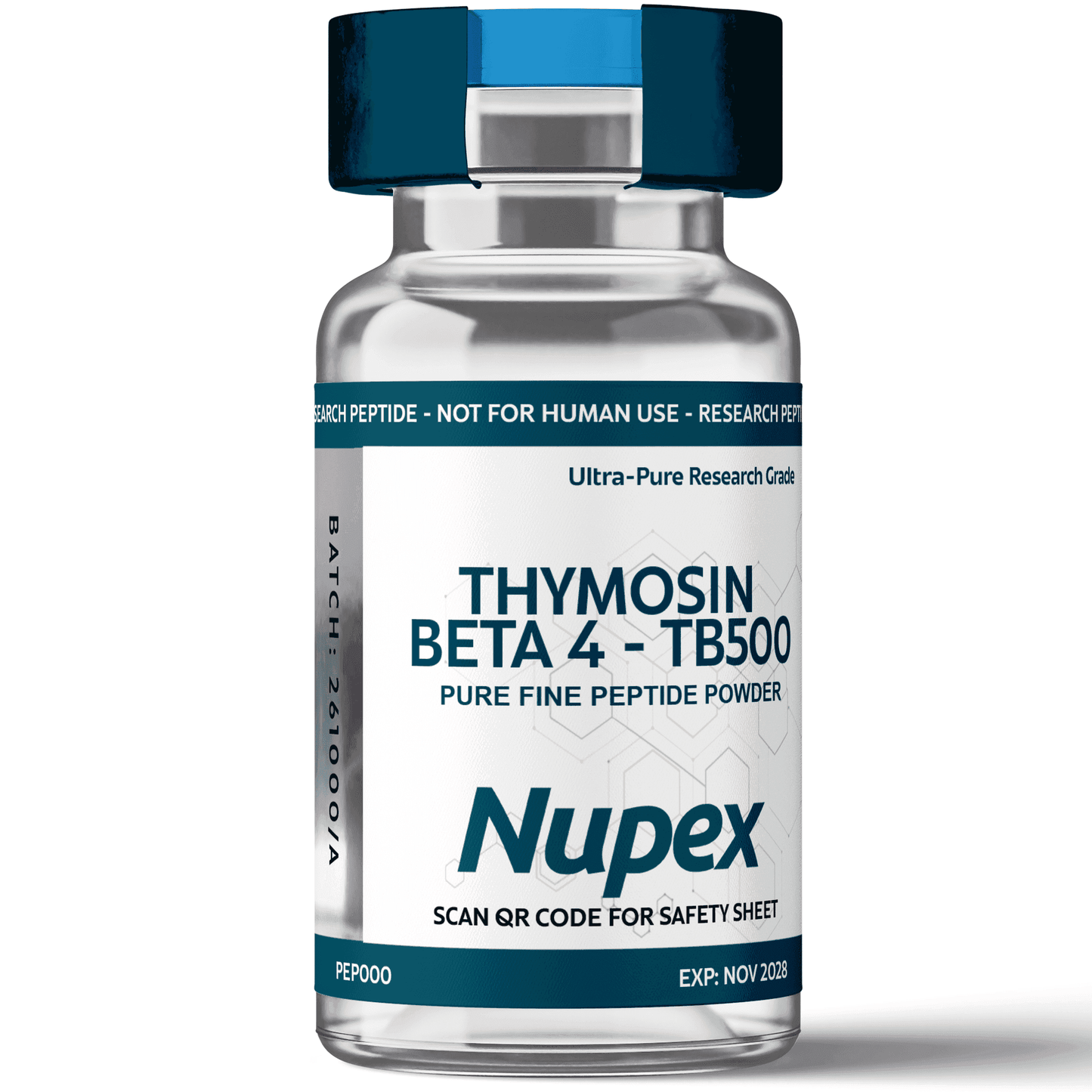
THYMOSIN BETA 4 TB500 - Research Grade Peptide
THYMOSIN BETA 4 TB500 - Research Grade Peptide
Couldn't load pickup availability
THYMOSIN BETA-4 TB500 (FULL-LENGTH) – Research-Grade 43-Residue Peptide
For research purposes only. This product is supplied exclusively for scientific laboratory research and analytical purposes. It is not intended for human or animal use, consumption, clinical use or therapeutic application. It must not be used in any way that contravenes applicable laws or the requirements of the Medicines and Healthcare products Regulatory Agency.
- Research-grade full-length thymosin beta-4 peptide with batch documentation available where supplied
- Defined 43-residue timbetasin structure containing covalent N-terminal acetylation
- Full-length molecular identity corresponding to CAS number 77591-33-4
- Supplied as measured dry or lyophilised laboratory material in sealed flip-top headspace vials
- Batch identity, chromatographic purity, peptide content, molecular form and analytical specifications stated in the applicable Certificate of Analysis
- Handled and supplied exclusively as a research-use laboratory material
This PEP056 product is intended to represent full-length thymosin beta-4, also known by the recognised substance name timbetasin. The defined molecule is a linear 43-residue peptide containing covalent N-terminal acetylation and a free C-terminal carboxylic acid. Each vial contains measured laboratory material prepared to support controlled scientific handling, storage, analytical method development and peptide characterisation. The stated nominal amount refers to the declared full-length thymosin beta-4 peptide content of a single vial, subject to the applicable batch documentation and stated assay basis.
Where dissolution or reconstitution is required, the solvent, buffer, concentration, mixing procedure and storage conditions stated in the applicable Certificate of Analysis, Safety Data Sheet or validated laboratory method should be followed. A universal solvent instruction should not be applied to every chemical form, counter-ion presentation or formulated preparation. We do not provide advice or recommendations concerning dosage, administration or use in humans or animals.
This PEP056 listing specifically describes full-length N-terminally acetylated thymosin beta-4 or timbetasin , comprising 43 amino-acid residues. Its molecular formula is C212H350N56O78S, and its average molecular weight is approximately 4,963.5 g/mol.
The term TB-500 is also used for a separate seven-residue thymosin beta-4 fragment with the sequence Ac-Leu-Lys-Lys-Thr-Glu-Thr-Gln-OH, abbreviated Ac-LKKTETQ-OH. That shorter fragment is not chemically identical to the full-length 43-residue molecule described on this page.
The applicable PEP056 Certificate of Analysis should confirm the complete 43-residue sequence, N-terminal acetylation, molecular formula, measured molecular mass and CAS number 77591-33-4. Where analytical testing instead identifies the shorter Ac-LKKTETQ fragment, a separate product page, Certificate of Analysis, Safety Data Sheet and catalogue identity must be used.
ULTIMATE THYMOSIN BETA-4
Full-Length 43-Residue Peptide with Additional HPLC Purification
Additional preparative high-performance liquid chromatography purification and a more stringent bacterial endotoxin and lipopolysaccharide testing specification for demanding scientific laboratory workflows.
The ULTIMATE full-length Thymosin Beta-4 range is our premium research specification for laboratories requiring an enhanced level of peptide purification and quality control. Following the standard synthesis and purification process, the finished 43-residue thymosin beta-4 research material undergoes an additional preparative high-performance liquid chromatography purification stage designed to reduce residual full-length peptide-related, deletion-sequence, truncation, oxidation-related, synthesis-related and process-related impurities further.
ULTIMATE batches are also assessed under a more stringent bacterial endotoxin and lipopolysaccharide testing specification. The applicable analytical method, reporting units, acceptance criterion and batch result should be stated in the corresponding Certificate of Analysis where supplied.
ULTIMATE Thymosin Beta-4 remains strictly for scientific laboratory research and analytical use only. It is not intended for human or animal use, clinical use, diagnostic use or therapeutic application. Molecular identity, full-length amino-acid sequence, N-terminal acetylation, chromatographic purity, peptide content, molecular form, counter-ion content, methionine oxidation, bacterial endotoxin results and other analytical specifications are batch-specific and should be confirmed using the applicable Certificate of Analysis. Bacterial endotoxin or lipopolysaccharide testing does not constitute sterility testing.
Chemical and Structural Information:
- Catalogue Product Name: THYMOSIN BETA-4 TB500
- Defined PEP056 Identity: Full-length N-terminally acetylated thymosin beta-4
- Preferred Substance Name: Timbetasin
- Alternative Names: Thymosin beta-4; Thymosin β4; Tβ4; beta-thymosin 4; full-length human thymosin beta-4
- Catalogue-Naming Clarification: The designation TB500 or TB-500 is used inconsistently. This PEP056 product specifically describes full-length thymosin beta-4 and not the separate seven-residue Ac-LKKTETQ fragment.
- Material Classification: Synthetic N-terminally acetylated linear 43-residue peptide
- Sequence Length: 43 amino-acid residues
- Complete Modified Peptide Sequence: Ac-Ser-Asp-Lys-Pro-Asp-Met-Ala-Glu-Ile-Glu-Lys-Phe-Asp-Lys-Ser-Lys-Leu-Lys-Lys-Thr-Glu-Thr-Gln-Glu-Lys-Asn-Pro-Leu-Pro-Ser-Lys-Glu-Thr-Ile-Glu-Gln-Glu-Lys-Gln-Ala-Gly-Glu-Ser-OH
- Modified One-Letter Sequence: Ac-SDKPDMAEIEKFDKSKLKKTETQEKNPLPSKETIEQEKQAGES-OH
- N-Terminal Structure: Covalently N-acetylated serine
- C-Terminal Structure: Free serine carboxylic acid terminus
- Cyclic or Linear Structure: Linear peptide
- Cysteine Content: None
- Disulphide-Bond Content: None; the full-length thymosin beta-4 sequence contains no cysteine residues
- Methionine Content: One methionine residue
- Sulphur Content: The single sulphur atom in the molecular formula is contributed by the methionine residue
- CAS Number: 77591-33-4
- PubChem Compound Identifier: CID 16132341
- Unique Ingredient Identifier: 2D5MRE3SSY
- Molecular Formula: C212H350N56O78S
- Average Molecular Weight: Approximately 4963.5 g/mol
- Approximate Molecular Size: 4.96 kDa
- Calculated Monoisotopic Mass: Approximately 4960.4863 Da
- Formula Basis: The molecular formula and molecular weight describe the full-length, N-terminally acetylated timbetasin molecule without additional acetate, trifluoroacetate, residual water, solvents or formulation excipients
- Separate TB-500 Fragment Identity: N-acetylated thymosin beta-4 residues 17–23
- Separate TB-500 Fragment Sequence: Ac-Leu-Lys-Lys-Thr-Glu-Thr-Gln-OH
- Separate TB-500 Fragment Shorthand: Ac-LKKTETQ-OH
- Separate TB-500 Fragment CAS Number: 885340-08-9
- Separate TB-500 Fragment PubChem Compound Identifier: CID 62707662
- Separate TB-500 Fragment Unique Ingredient Identifier: QHK6Z47GTG
- Separate TB-500 Fragment Molecular Formula: C38H68N10O14
- Separate TB-500 Fragment Average Molecular Weight: Approximately 889.0 g/mol
- Fragment Distinction: The seven-residue Ac-LKKTETQ fragment and the full-length 43-residue thymosin beta-4 molecule are separate chemical substances and should not share a Certificate of Analysis, molecular formula, molecular weight or mass-spectrometry acceptance criterion
- Physical Form: Dry powder or lyophilised laboratory material, as stated in the applicable batch Certificate of Analysis
- Appearance: White to off-white laboratory material, subject to confirmation in the applicable batch Certificate of Analysis
- Purity Specification: The applicable chromatographic purity result, analytical method and acceptance criterion should be stated in the batch Certificate of Analysis
- Purity Interpretation: Chromatographic purity represents the relative chromatographic composition measured under the stated analytical conditions and does not by itself establish full-length molecular identity or total net peptide content
- Peptide-Content Specification: Net full-length thymosin beta-4 content should be distinguished from chromatographic purity and interpreted alongside water, counter-ion, residual-solvent and formulation results
- Nominal Amount Basis: The applicable product specification should state whether the declared vial quantity is expressed as net timbetasin peptide equivalent or as total supplied salt-form or formulated material
- Full-Length Sequence Confirmation: The complete 43-residue sequence should be confirmed using the applicable supplier, synthesis and batch records
- N-Terminal Acetylation Confirmation: Product identity should confirm the covalent N-terminal acetyl group using suitable mass-spectrometry or equivalent molecular-identity data
- C-Terminal Confirmation: Molecular-identity documentation should confirm the free C-terminal serine carboxylic acid structure
- Mass-Spectrometry Confirmation: Molecular identity should be supported by analytical mass data consistent with the complete approximately 4.96 kDa timbetasin molecule rather than the separate seven-residue TB-500 fragment
- Chemical-Form Confirmation: The applicable Certificate of Analysis should identify whether the supplied material is the uncountered parent peptide, an acetate-containing form, a trifluoroacetate-containing form or another counter-ion presentation
- Counter-Ion Specification: Acetate, trifluoroacetate or another counter-ion may affect the total supplied material mass and calculated net peptide content
- Water-Content Specification: Residual water may contribute to the total material mass and should be stated or controlled through the applicable batch specification
- Residual-Solvent Specification: Applicable residual solvents arising from peptide synthesis, cleavage, purification, concentration and lyophilisation should be stated or controlled through the batch specification
- Methionine-Oxidation Control: Oxidation of the single methionine residue is a distinct peptide-related quality attribute and should be assessed or controlled where required by the applicable batch specification
- Related-Impurity Control: Deletion sequences, truncated peptides, incompletely acetylated material, methionine oxidation products, incompletely deprotected sequences and other synthesis-related or process-related substances are separate quality attributes
- Dissolution Method: The appropriate solvent, buffer, concentration and mixing procedure should be selected using the applicable batch documentation and validated laboratory method; a universal bacteriostatic-water instruction should not be applied to every thymosin beta-4 chemical form or formulation
- Endotoxin Specification: The applicable bacterial endotoxin or lipopolysaccharide result, analytical method, reporting units, method-suitability controls and acceptance criterion should be stated in the batch Certificate of Analysis
- Sterility Distinction: A bacterial endotoxin or lipopolysaccharide result does not establish sterility. Sterility should only be claimed where supported by an appropriate validated sterility test and controlled filling process
- Analytical Interpretation: Molecular identity, full-length amino-acid sequence, N-terminal acetylation, terminal structure, chromatographic purity, net peptide content, methionine oxidation, water content, residual solvents, counter-ion content and bacterial endotoxin results are separate analytical measurements and should be interpreted together
✓ Batch documentation – Completed Certificate of Analysis documentation is provided where supplied for the applicable batch.
✓ Certificate of Analysis – Accessible through the product QR code where a completed batch-specific document has been published.
✓ Safety Data Sheet – Supplied to support appropriate laboratory handling, storage and regulatory compliance.
✓ Full-length sequence documentation – The complete 43-residue thymosin beta-4 sequence should be confirmed using the applicable synthesis and batch records.
✓ N-terminal modification documentation – Covalent N-terminal acetylation should be supported by appropriate molecular-identity data.
✓ C-terminal structure documentation – The free C-terminal serine carboxylic acid structure should be confirmed using the applicable molecular-identity records.
✓ Mass-spectrometry documentation – Molecular identity should be supported by analytical mass data consistent with the complete approximately 4.96 kDa timbetasin molecule.
✓ Fragment distinction – The analytical documentation should distinguish full-length thymosin beta-4 from the separate seven-residue Ac-LKKTETQ TB-500 fragment.
✓ Purity documentation – The reported chromatographic purity applies only to the analytical method and batch stated in the Certificate of Analysis.
✓ Peptide-content documentation – Net full-length thymosin beta-4 content should be distinguished from chromatographic purity and interpreted alongside water, counter-ion and residual-solvent results.
✓ Chemical-form documentation – The parent peptide, acetate-containing material, trifluoroacetate-containing material or another counter-ion presentation should be identified clearly in the applicable product and batch records.
✓ Oxidation-control documentation – Methionine oxidation should be assessed or controlled where required by the applicable research specification.
✓ Bacterial endotoxin documentation – The applicable bacterial endotoxin or lipopolysaccharide result should identify the analytical method, reporting units, method-suitability controls and acceptance criterion.
✓ Supplier documentation – Reviewed where supporting synthesis, purification and analytical records are supplied.
✓ Fast, reliable and trackable express delivery – Securely packaged and dispatched using insulated or temperature-managed packaging where required by the applicable transport and storage specification.
For Research Use Only
This product is supplied strictly for scientific research, laboratory analysis and experimental work. It is not intended for human consumption, animal use, clinical use, diagnostic use or any form of therapeutic application.
Thymosin Beta-4 TB500 Product Overview
Our full-length Thymosin Beta-4 research-grade peptide, also identified by the recognised substance name timbetasin, is supplied for controlled scientific laboratory investigation, analytical method development, full-length peptide characterisation, high-performance liquid chromatography assessment, mass-spectrometry workflows and reference-material comparison.
The PEP056 molecular identity comprises a defined linear sequence of 43 amino-acid residues with covalent N-terminal acetylation and a free C-terminal serine carboxylic acid. The molecule contains no cysteine residues and therefore has no intramolecular disulphide bonds. Its single sulphur atom is contributed by the methionine residue within the sequence.
The CAS number 77591-33-4, molecular formula C212H350N56O78S and average molecular weight of approximately 4963.5 g/mol describe the full-length, N-terminally acetylated timbetasin molecule. Where the supplied material contains acetate, trifluoroacetate, residual water, solvents or formulation ingredients, the applicable batch documentation should identify their contribution to the total supplied material mass.
Full-length thymosin beta-4 should not be confused with the separate seven-residue material also recorded under the TB-500 name. That fragment has the sequence Ac-LKKTETQ-OH and a molecular weight of approximately 889.0 g/mol. High-performance liquid chromatography purity alone cannot establish which of these two substances has been supplied; the catalogue identity, complete sequence and mass-spectrometry result must agree.
The material is handled with a focus on batch traceability, documented quality control and consistent laboratory presentation. Product identity, full-length amino-acid sequence, N-terminal acetylation, chromatographic purity, net peptide content, molecular form, counter-ion content, water content, residual solvents, methionine oxidation, bacterial endotoxin results and other analytical specifications should be confirmed using the applicable batch Certificate of Analysis.
Chromatographic purity should not automatically be interpreted as equivalent to total net peptide content or proof of the complete 43-residue sequence. Likewise, a bacterial endotoxin or lipopolysaccharide result does not establish sterility, full-length molecular identity, correct N-terminal acetylation or the absence of every peptide-related and process-related impurity.
For the majority of routine analytical, chromatographic, peptide-characterisation and general laboratory work, the Regular full-length Thymosin Beta-4 specification remains highly suitable. The premium black-and-gold ULTIMATE Thymosin Beta-4 option provides an additional preparative high-performance liquid chromatography purification stage and a more stringent bacterial endotoxin and lipopolysaccharide testing specification for scientific projects requiring enhanced quality-control parameters.
Share